
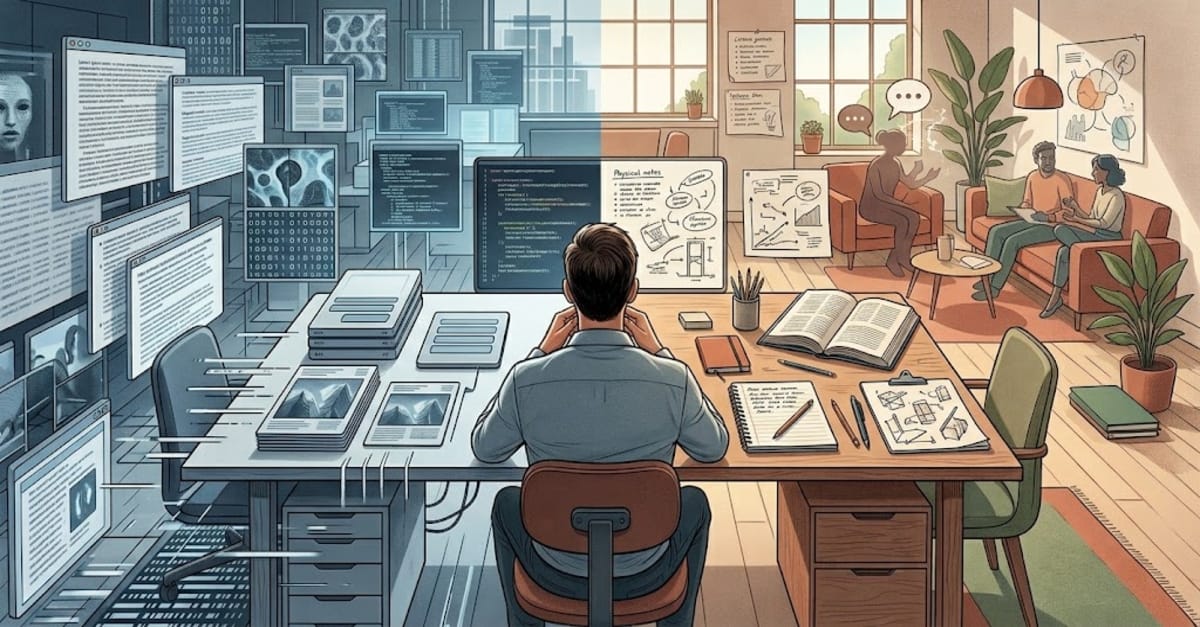
This started as a conversation with the team. We were talking about AI and the future of work, where it is heading and whether it is actually getting better. We’ve previously talked about AI and Education back in 2023 and we were reflecting on how that works in the workplace and is the future of work changing?
There was no shortage of opinions. Some of us were looking at our growing dependence on AI. We talked about creativity, critical thinking, hallucinations and the strange prospect of AI learning from content created by AI.
The conclusion from that side of the table was fairly simple. Maybe AI is going to hell in a handcart.
But there was another view. The same technology could remove drudgery, give us back time and create more space for human creativity, judgement and connection.
So rather than decide who was right, I was challenged to write up both sides and put both arguments on the table.
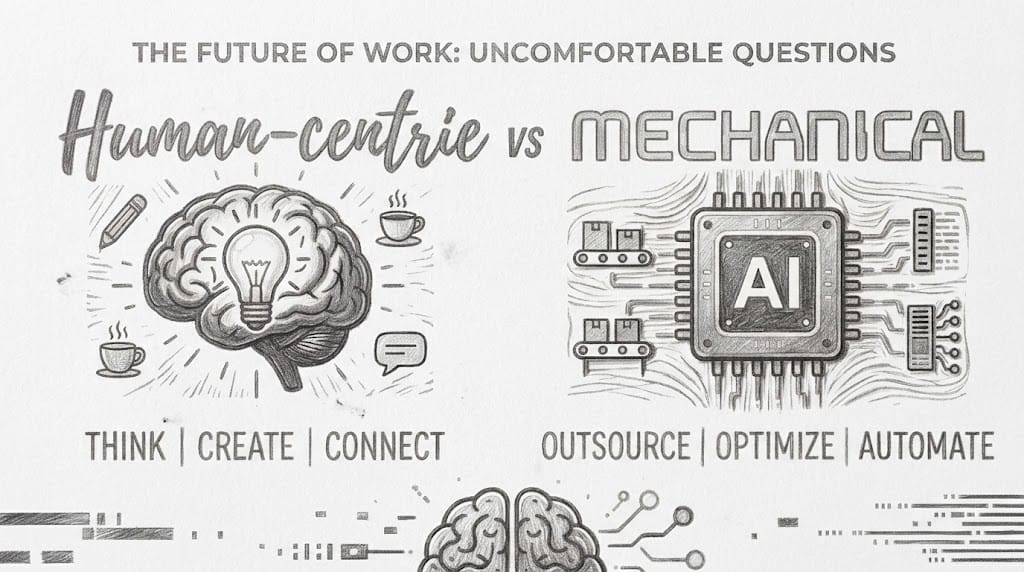
Two
perspectives.
One
conversation.
You can decide where you sit.
AI and the Future of Work
CON:
AI Is Going to Hell in a Handcart and Taking Us With It
A few years ago, asking an AI to write an email felt like magic.
Today, asking it to write an email feels ordinary. Somewhere between those two moments, something changed.
Not in the technology itself, although that has evolved at remarkable speed. What changed was us.
We stopped treating AI as a tool and started treating it as a source of truth. Every day I see people asking language models to think for them, write for them, decide for them and increasingly create for them. Meetings begin with “I asked ChatGPT…” instead of “I was thinking…” as if AI was a member of the team. Research starts and ends with an AI summary. Creativity becomes prompting rather than imagining.
It feels efficient. It feels dangerous even.
The uncomfortable truth is that large language models don’t understand the world in the same way humans do. At their core, they generate language by predicting what comes next from patterns learned during training. They generate the next most probable token based on patterns learned from unimaginably large datasets. They can produce extraordinary results, but they can also fabricate convincing nonsense. We softened this reality by inventing a new word. It sounds almost charming. Creative, even.
Hallucination.
- Imagine if your spreadsheet hallucinated your tax return.
- Imagine if your satnav hallucinated a bridge.
- Imagine if your banking software hallucinated your account balance.
We would call those systems broken. AI deserves the same scrutiny.
The problem becomes even more interesting when AI-generated content starts becoming part of the data used to train future models.
Researchers have begun investigating what happens when future models are trained on increasingly AI-generated content. The concern is known as model collapse. As synthetic content begins to outweigh human-created material, models risk amplifying their own errors while gradually losing diversity and nuance. It is less like intelligence evolving and more like repeatedly photocopying a photocopy.
- The internet itself is changing.
- Blogs are written by AI.
- Marketing copy is generated by AI.
- Images are generated by AI.
- Code is generated by AI.
Soon the training data increasingly becomes AI describing a world originally described by humans.
That should make us pause. Then there is society itself.
Critical thinking is hard work. Creativity is uncomfortable. Solving difficult problems requires time, failure and reflection. AI offers ‘instant answers’.
Like any shortcut, it is incredibly useful until it quietly replaces the journey that taught us something.
- There is a difference between using a calculator and forgetting how numbers work.
- There is a difference between using satnav and forgetting how to navigate.
- There is a difference between using AI to accelerate thinking and allowing it to become the thinking.
History suggests humans are remarkably good at outsourcing effort. Physical effort gave way to machinery. Mental arithmetic gave way to calculators. Navigation gave way to GPS.
Perhaps reasoning is next. That is not an argument against AI. It is an argument against complacency.
Ironically, the more capable AI becomes, the more valuable human judgement becomes. The organisations that thrive will not be those that trust AI the most. They will be those that know precisely when not to.
The future does not scare me because machines might become too intelligent.
It concerns me because people might become comfortable being just intelligent enough to accept whatever the machine says.
That is a very different risk. One that no model can solve for us.
PRO:
Yes, But… AI Was Never Meant to Replace Us
After reading everything written about AI over the past few years, you would be forgiven for believing civilisation is either about to end or become effortless.
Neither is true. AI is neither our salvation nor our downfall.
It is infrastructure.
Like electricity, the internet and the smartphone before it, its real impact will not come from the technology itself. It will come from how humans choose to use it.
That distinction matters.
Some of the loudest voices in technology frame AI as though humans are simply an inefficient stage in evolution. The implication is clear. Thinking is expensive. Creativity is slow. Decision making is flawed. Machines will eventually do it better.
I disagree.
Human value has never been measured by speed alone.
Empathy cannot be tokenised.
Trust cannot be generated.
Wisdom is not simply information compressed into a larger context window.
Leadership is not predicting the next word.
These remain profoundly human capabilities.
AI is extraordinary at removing friction.
- It can summarise thousands of pages in seconds.
- It can analyse patterns invisible to individuals.
- It can democratise expertise that was previously inaccessible.
- It can eliminate repetitive work that drains both time and motivation.
That is not replacing people.
That is giving people more room to be people.
Throughout history, technology has repeatedly changed the nature of work rather than eliminating humanity from it. Spreadsheets did not remove accountants. CAD software did not remove engineers. Search engines did not remove curiosity.
They changed where people added value.
AI will do exactly the same.
The organisations that succeed will not be those with the biggest models. They will be those that develop the strongest cultures of judgement.
- Employees will need to ask better questions.
- Leaders will need to challenge outputs instead of accepting them.
- Educators will need to teach reasoning alongside prompting.
The skill of the future may not be writing the perfect prompt. It may be recognising when the answer is wrong.
Perhaps the biggest opportunity lies elsewhere.
AI has the potential to return something that modern work has steadily eroded.
Time.
- Time to mentor.
- Time to create.
- Time to build relationships.
- Time to solve genuinely difficult problems instead of spending entire careers moving information from one document to another.
Used well, AI does not diminish humanity.
It amplifies it.
It can amplify the imagination, but it can also amplify bias and error. The human will need to be able to spot this.
The question has never been whether machines can think.
The question is whether humans will choose to think more deeply because machines can handle everything else.
That feels like a future worth building.
Not because AI becomes more human.
But because humans become more human.
AI is simultaneously the greatest productivity tool of our generation and one of the greatest tests of human judgement we’ve ever created.
Maybe we’ve been asking the wrong question.
The debate isn’t really about whether AI is good or bad for the future of work. It isn’t even about whether AI will replace us.
The more uncomfortable question is what we are becoming as we use it.
- If AI writes the first draft, do we still have something worth saying?
- If AI finds the answer, do we still understand the question?
- If AI makes the decision, who owns the consequence?
And what does that look like inside our organisations?
- Are we using AI to challenge our thinking, or to avoid it?
- Are we using it to unlock creativity, or quietly replacing our own?
- Are we removing the drudgery so people have more time to think, or simply finding new ways to do more, faster?
The smartest thing AI can do for us is give us back the time to think for ourselves.
Perhaps you changed your mind while reading this. That’s OK. I’ve yoyo’d between each side all the way through, and I don’t even think I sit comfortably on one side even now.
In fact, that might be the most human thing that happened here.
AI is going to keep getting better. That part is almost inevitable. The harder challenge is making sure we don’t become worse at being human because of it.
So perhaps the organisations that thrive won’t be the ones that automate the most. They will be the ones that understand what should never be automated.
The real test of AI isn’t what we can make it do, but what we choose not to let it do.
And perhaps the most important AI skill isn’t prompting, coding or knowing which model to use.
Perhaps it is knowing when to put the machine down and think for yourself.
*Hint …
Oh … and if this blog wasn’t enough and you want to know some more of my thoughts, I did a talk with the Manchester Statistical Society on this topic focussing on the CON side of the chart here:
https://www.youtube.com/live/RTuPRfIbuzU?si=X8T4qduv1bf3jgO1
AI Transparency Statement
I used Google Gemini to produce the images.
Grammarly (free edition) was used for spell-checking.


Leave a Reply